
For consultancies, agencies and fractional teams
Win the client and scope the project in days, not weeks.
AI does the outreach research and the discovery interviews. Your people approve everything. DiscoverPro finds the companies worth writing to, interviews your client's team, sizes every problem in their own numbers and hands you the readback, the proposal and the agreements.
A real DiscoverPro proposal for a demo client: scope, fee, services agreement and signature record. The agreement in it is sample text. Each firm loads its own NDA, services agreement and prices. PDF, 9 pages.
What it saves your firm
Estimates, compared with doing the same work by hand. See how they add up over a month, and put in your own numbers.
- ResearchWho is worth a conversation, and why now
- OutreachA short, specific note a person approves
- InterviewThe client and their team talk it through
- AssessmentEach problem sized from their own figures
- ReadbackFindings walked through on a call
- ProposalA scoped first step, signed online
Why firms use it
Outreach and discovery eat the hours you could be billing. This is how it stops.
Outreach is slow, or it is generic
Researching a company properly takes half an hour, so most firms skip it and send everyone the same email. Nobody answers.
With DiscoverPro Every company is researched and scored, and the first message is written in your voice from a real reason to write now. You read it and approve it in about five minutes.
Discovery eats your senior people
Interviews, notes, analysis and slides take about sixty hours of the people you can least spare, usually before a dollar is billed.
With DiscoverPro The interviews, the write-up, the sizing and the decks arrive done. Your senior people spend about seven hours reading, correcting and approving.
The result depends on who ran it
One consultant asks how often and how long. Another forgets. The proposal is only as good as the notes, and the client can tell.
With DiscoverPro Every person is asked the same thorough questions, every answer is kept in their own words, and a gap check shows what is still missing before you write a line.
It takes too long to reach a proposal
Weeks pass between the first call and the numbers. Interest cools, and the first conversation was hard enough to win.
With DiscoverPro People are interviewed on their own time, with no calendars to line up. The assessment, the readback and a priced proposal are drafted as soon as the answers are in.
Check it yourself
Don't take our word for it. Try it, read it, time it.
Outreach
Start with a reason to talk.
Cold email fails when it could have been sent to anyone. Outreach finds the companies, does the reading, scores them, finds the right person and drafts the message. Nothing goes out without a person saying yes. A company that says yes arrives in Discover with its research attached.
Sourcing
Bring companies in from wherever your list lives. Duplicates are merged, and anyone who has opted out is left out.
- A file. Upload a CSV or Excel list. Columns are matched for you, and the match is remembered for the next file with the same headings.
- A pasted list, or one by hand. One company name or website per line, or a single company with its contact.
- A Google Sheet. Link a sheet and new rows are pulled in every day. Rows already imported are updated, never duplicated.
- A provider search. Search Apollo, Hunter or A-Leads by keyword, place and size, untick the ones you do not want, and import the rest.
- Your LinkedIn connections. Upload each person's connections export. Anyone who works at a company on your list is marked as known, and that company becomes a warm one.
- Research now, or hold it. Import and research straight away, or store the list and choose which companies are worth researching. Nothing is spent on the ones you hold.
Research
Before anyone writes a word, the tool reads up on the company and shows its sources.
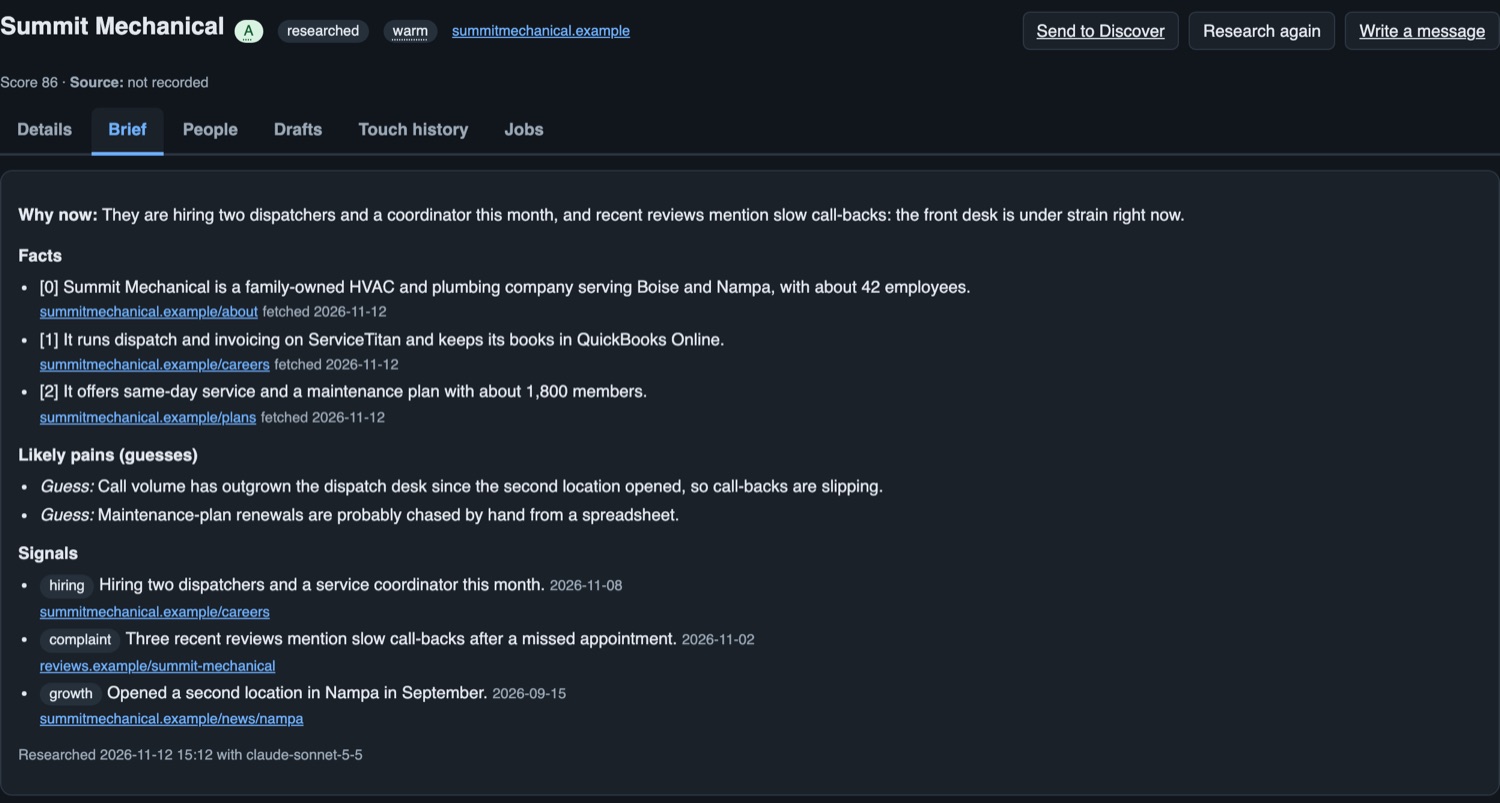
- A brief for each company. What they do, who they serve, and the facts that matter, each with a link to where it was found.
- Signals. Hiring, growth, reviews, new locations and other signs of a problem worth solving, dated and sourced.
- Why now. One line on why this is the moment to write, and the hypotheses worth testing in a first conversation.
- The website found for you. If a company came in by name only, its site is found first, then read.
- Research again when you like. A company that has changed can be researched again, and you can research one the fit check turned down.
- Every run costed. The cost of each research run is on the record, and each data provider has a monthly budget it cannot exceed.
Fit and scoring
A quick, cheap check decides whether a company deserves full research, and a score decides who is first in the queue.
- Your fit rules. The size range and the countries you work in, and the kinds of company you do not want.
- A look before you pay. A fast read of the home page settles most cases before any full research is run.
- Not a fit, with the reason. Turned-down companies are kept with why, so you can overrule one.
- A score out of 100. Each company is scored against your rules, with the parts of the score shown, and placed in tier A, B or C.
- Warmth counts. Warm, referral, inbound or cold. Warm and referred companies always get researched and go to the front of the queue.
- Your rules, your weights. The fit rules and the scoring are yours to set.
Contacts
The right person at each company, with where each detail came from.
- People by role. The owner, the operations lead, the office manager: the roles you say you sell to.
- Found for you. From your data providers or the open web, with the source kept beside each person.
- Email and phone on request. Look up a missing email or phone number for one person when you need it, with the cost shown.
- Email status. Each address carries its status: unverified, valid, risky or invalid.
- Who knows them. A contact one of your people is connected to is marked with whose connection it is.
Drafts and queue
Messages are drafted from the brief. A person reads, edits and approves every one.
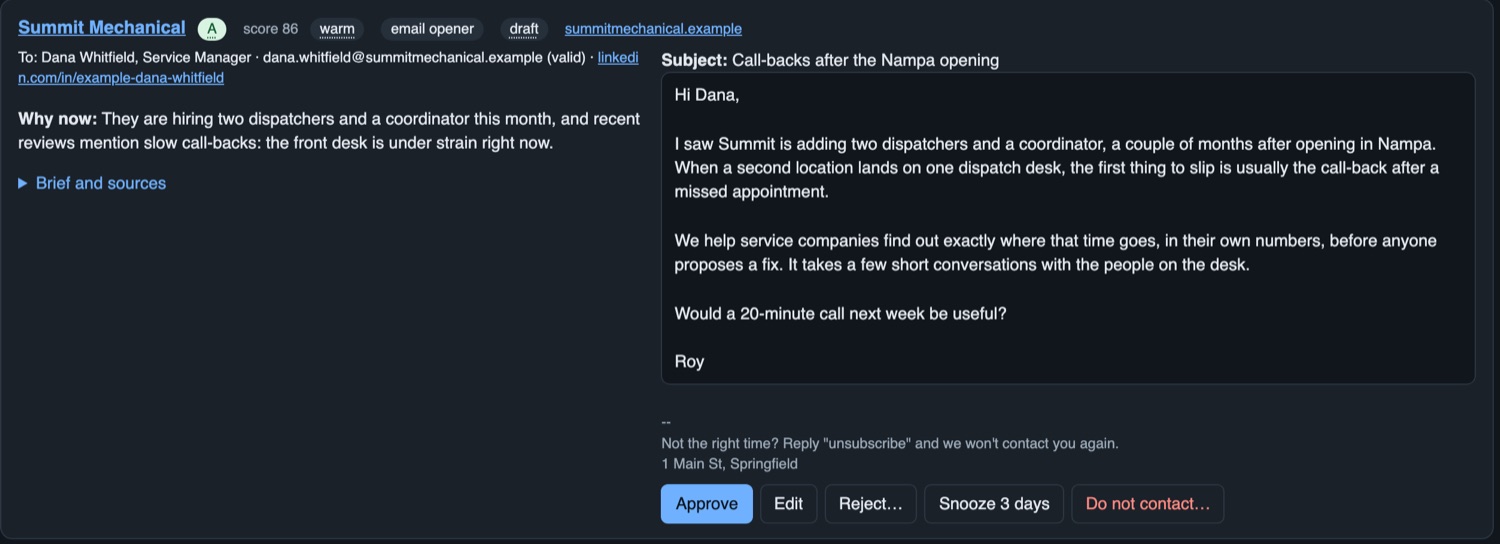
- An opener. A short first note about that company, by email or as a LinkedIn message to send yourself.
- An introduction request. Where you know someone there, a draft asking them to introduce you, in place of a cold note.
- Follow-ups. A sequence drafted from the same brief, each waiting for approval.
- A daily queue. A set number of drafts each day, warm companies first, then by score.
- Sent from your own mailbox. Approved emails go out from your own Gmail account, so replies come back to you.
- Your offer, your voice. The drafts are written from your description of what you sell and the templates you set.
Replies and hand-off
The sequence stops when it should, and a yes carries straight into discovery.
- A reply stops the sequence. Replies are picked up within minutes and the follow-ups for that person are cancelled.
- Unsubscribe on every email. Anyone who opts out is suppressed, and suppressed addresses and domains are skipped on every later import.
- A report. What was sent, what was answered and what it cost.
- One click into Discover. When a company agrees to a discovery, its research goes across with it and the outreach stops.
Discover
Weeks of discovery meetings, done in short sittings on the client's schedule.
Your client's sponsor and the people who do the work each get their own link. An AI interviewer asks how the work really gets done. You get findings you can defend, the decks to present them, and the agreements that close the project.
Try the interviewer yourself Two minutes, no sign-up. It sizes what discovery and outreach cost you today.
Set up
A client is ready to interview in minutes. Nothing has to be written first.
- The people. A sponsor, the colleagues who do the work, and whoever will sign. Each gets a personal link by email. No account, no password.
- NDA first. The sponsor signs your mutual NDA online before the first question.
- Questions, if you want them. Core questions for every sponsor, questions tailored to this client from your call notes, and your own library. Or none: the interviewer covers the ground for each role.
- Deep-dive areas. Add the areas worth a closer look, each with its own instructions and must-ask questions for the person who does that work.
- Your interviewer. Its name, its voice, and a playbook of how your firm likes an interview run.
- Reminders. A sponsor who goes quiet is nudged on the schedule you set, in working hours.
Interview
Each person talks or types with the AI interviewer, on their own time, and can do more than answer.
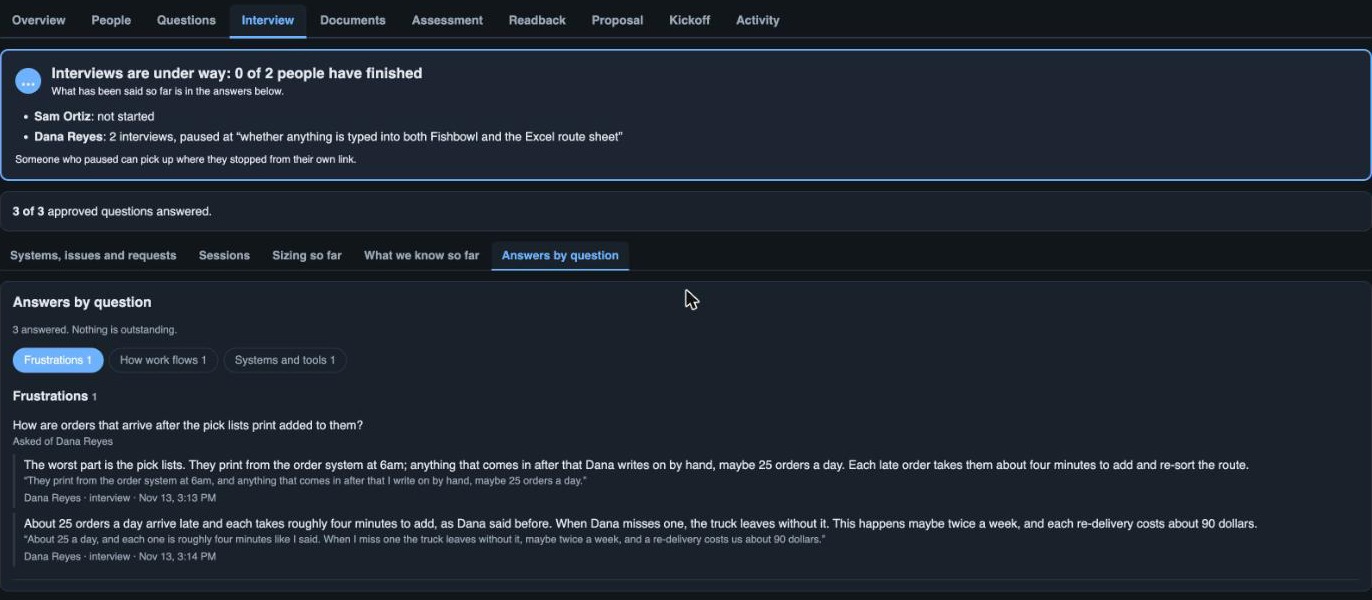
- By voice or by keyboard. The interviewer always says it is an AI, in English or Spanish, and follows up: how often, how long, who, in what tool, what goes wrong.
- Share a document. Mid-conversation, the person can upload the spreadsheet, form or report they are talking about.
- Record the screen. They can record themselves doing the task, so you see the steps instead of hearing them described.
- Refer a question to a colleague. "Ask our billing person" becomes an invitation to that person, with the question attached.
- Stop and come back. Each sitting has a time limit. People pause, pick a time to return, get a reminder, and carry on from the exact point they stopped.
- Ask for a person. Anyone can ask to talk to a human or ask how the process works, and you are told.
- Add more later. Someone who has finished can come back for a follow-up interview when they think of something else.
Evidence
Everything said and shown is written up, sorted and kept current.
- Answers in their words. Each answer is written up plainly, with the client's own words quoted beneath it.
- Documents and recordings read. Files, screenshots, voice notes and screen recordings are read, and the findings and figures in them are filed with the answers.
- Systems, issues and requests. One register across every interview: the tools they use, the problems, what they asked for, what they tried, their constraints and their key numbers.
- What we know so far. Per person: what is covered, what is still needed, and where they stopped.
- People mentioned. Anyone named as knowing more is listed with the questions waiting for them, ready to invite.
- A sizing checklist. For each problem: the trigger, the steps, who, how often, how long, what goes wrong and what it costs.
Assessment
Every opportunity is sized from the client's figures, with the inputs open for you to correct before you approve it.
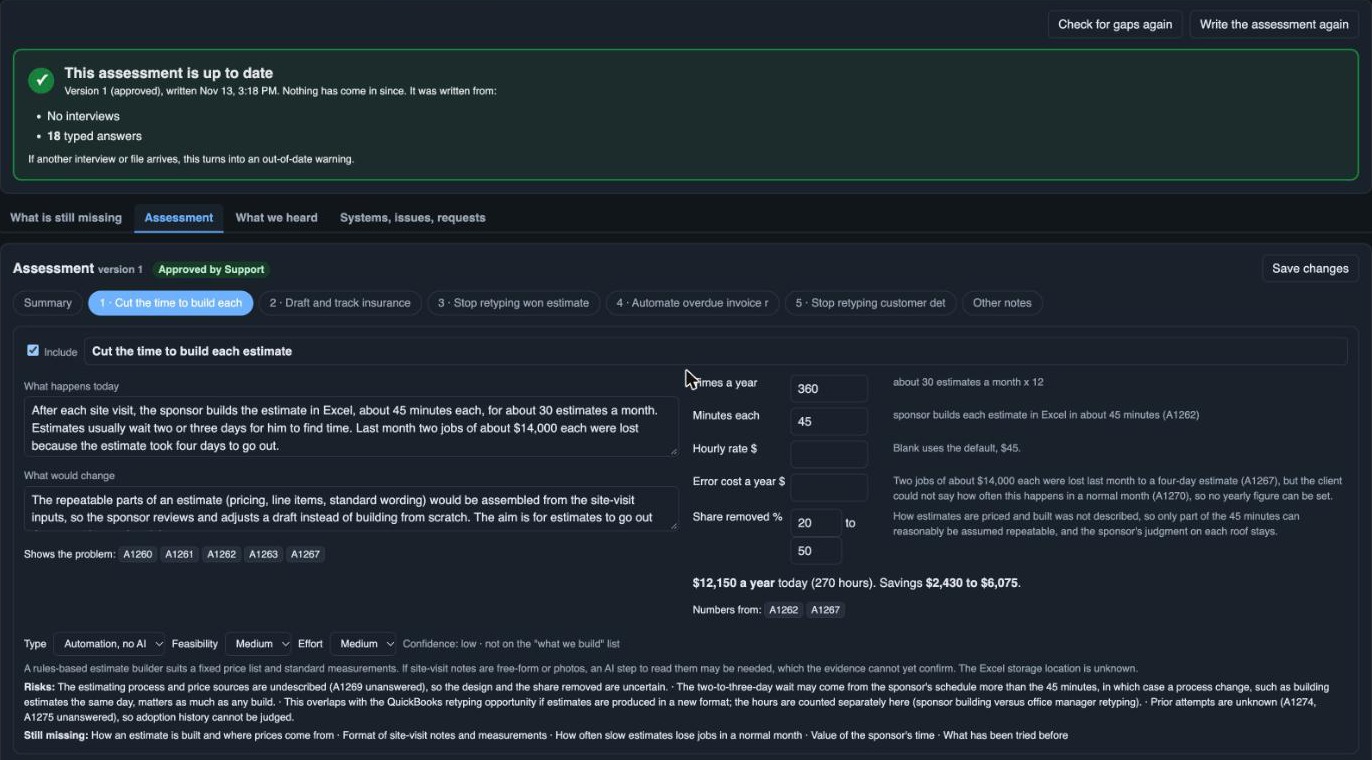
- A gap check first. What is still missing to size each problem, with follow-up questions drafted for you to send as a short second interview.
- Opportunities, by kind. AI-led, automation or a change in process, each with what happens today and what would change.
- Sized in their numbers. Times a year, minutes each, the rate and the cost of errors, taken from the evidence. The arithmetic is done in code and you can edit every input.
- Feasibility and effort. Each opportunity is rated, with the reason, the risks and what is still unknown.
- Their tools looked up. The software the client named is researched on the web for what can be connected to, with sources.
- Where to start. The best first step is picked out, and what you would not recommend is listed with why.
- Always current. The assessment says when new interviews or files have overtaken it, and a draft nobody has edited rewrites itself.
What we heard and readback
The client confirms the findings before you present them.
- What we heard. A plain summary goes to the sponsor, in their language, with no advice in it. They correct any point and confirm.
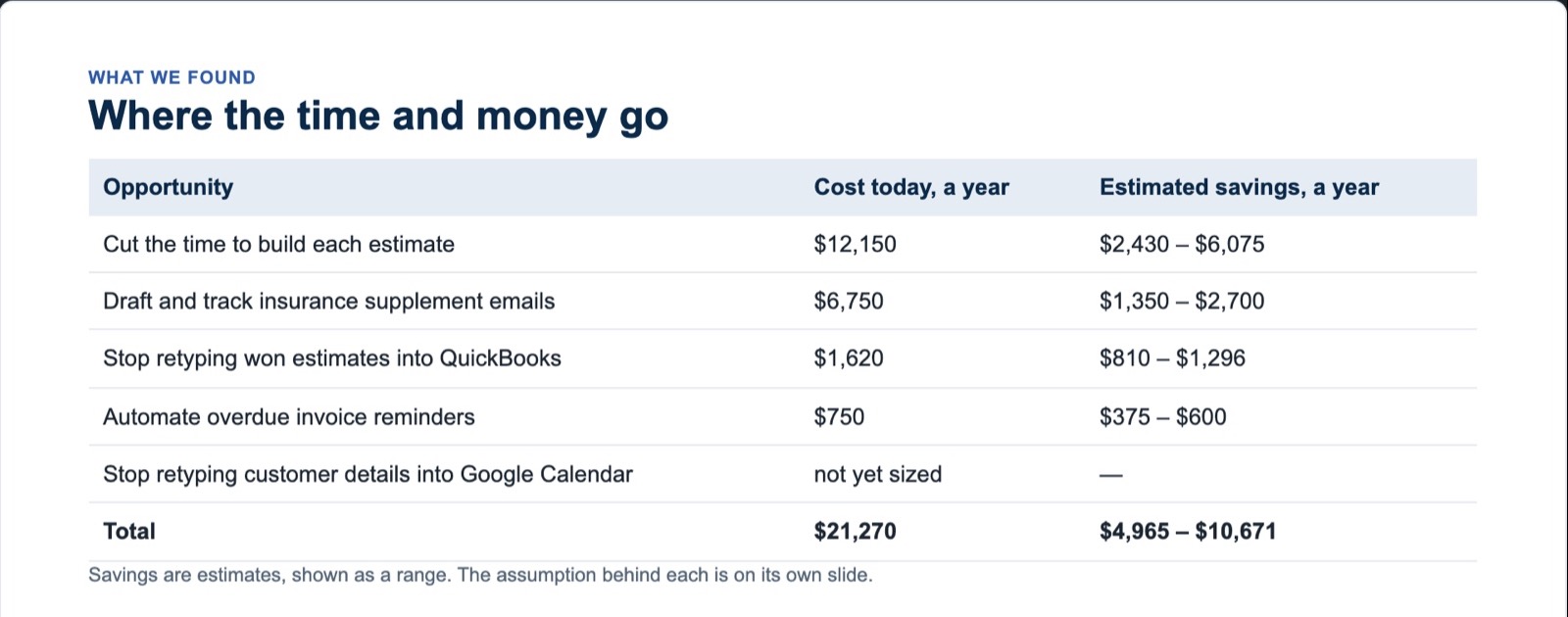
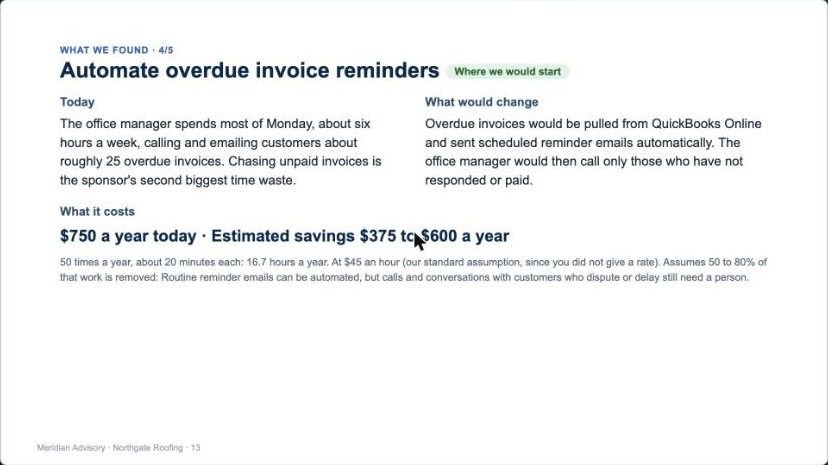
- A readback built from the approved assessment. What you did, what they told you, what you found, each finding with its cost and savings range, and where you would start.
- Walk it through, then release it. Present it on the call, then release it to the client's page to read afterwards.
- You can see it was opened. The record shows when the client opened the readback and the proposal.
Proposal and agreements
The opportunities you pick become a proposal the client can comment on and sign.
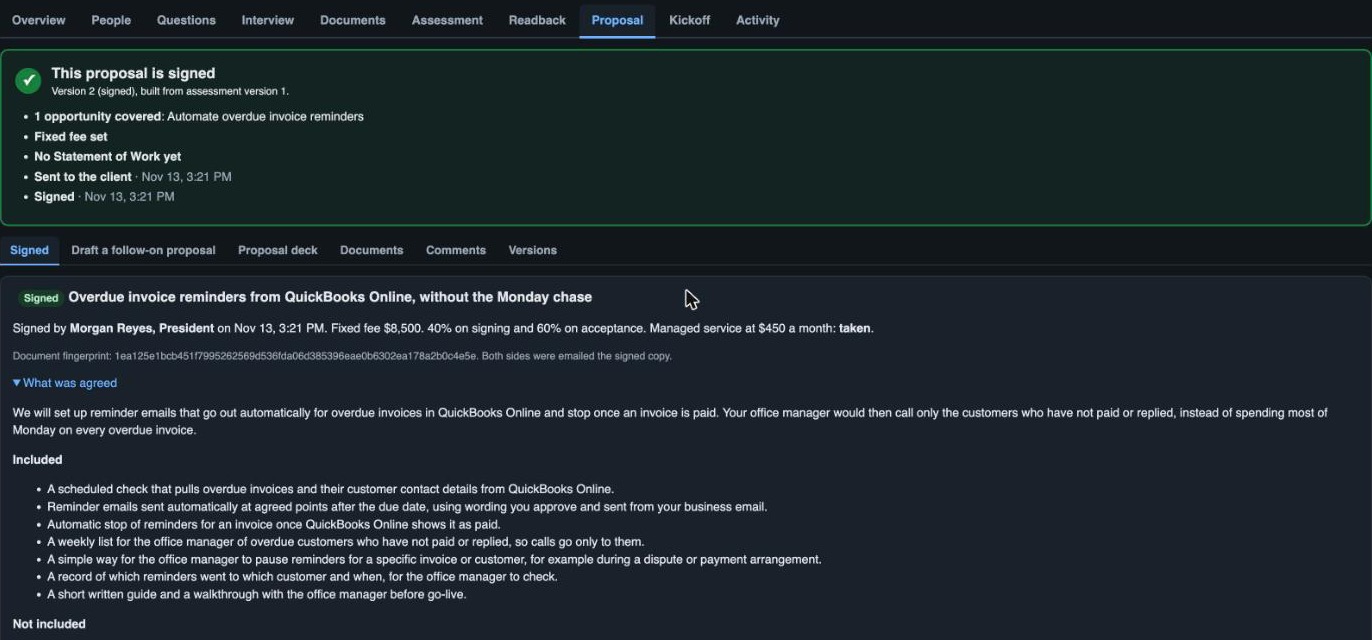
- Scope drafted for you. What is included, what is not, the phases, what the client provides, the assumptions and how success is judged.
- Priced from your price list. A fixed fee by size of work, and your managed service as an option the client says yes or no to. Prices are never written by AI.
- A Statement of Work for this engagement. Written from the approved scope, following your own example, with an acceptance test for each deliverable.
- Your Master Services Agreement. Your template is attached beneath the Statement of Work, with the client's name filled in.
- Comment, hand on, sign. The client comments, passes it to the person who signs, and signs online. The exact text signed is kept with its fingerprint and a signature record.
- Copies for everyone. The proposal and the signed copy as a page, a PDF or a Word file, for you and for the client.
- Versions and follow-ons. Revise a sent proposal as a new version, record payment, and offer the next piece of work to a client who has already signed.
Decks
Three decks, each built from what is already approved, ready to present.
- The readback deck. The findings, for the call where you walk the client through them.
- The proposal deck. The scope, the plan, the fee and what comes next, for the call where you propose.
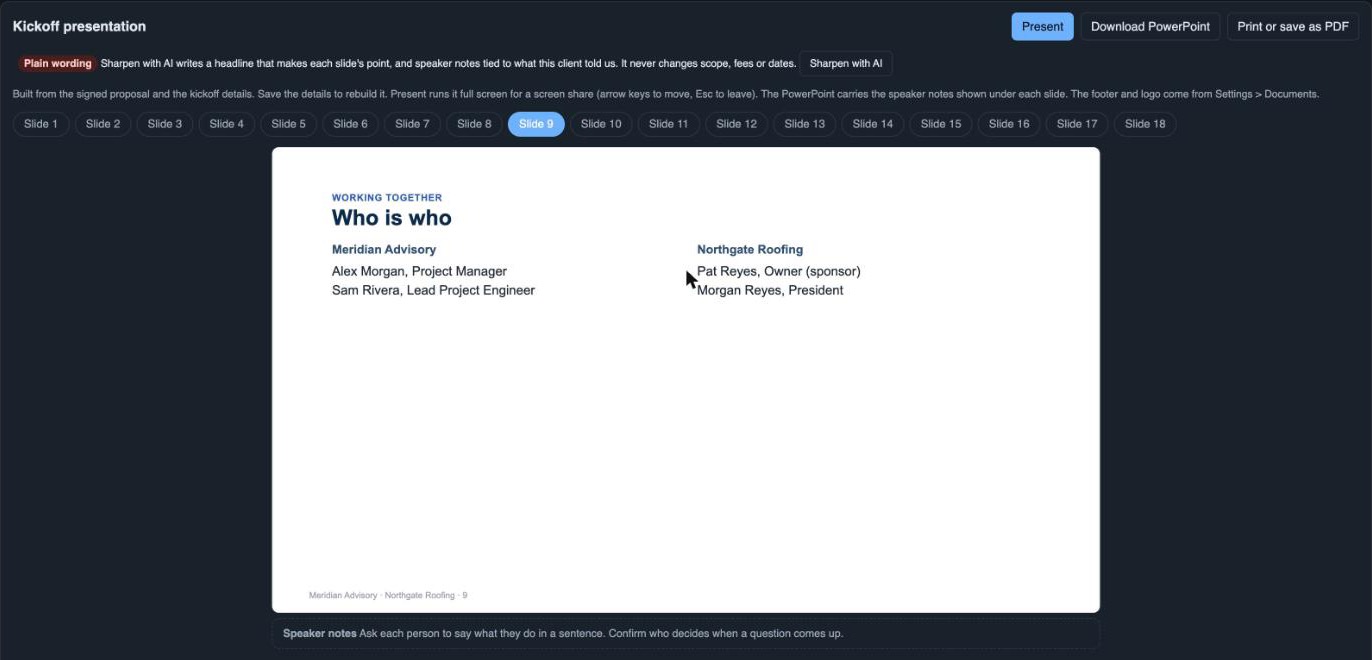
- The kickoff deck. Who is who, the plan, what you need from them, how you will work together and the first two weeks, with a meeting agenda.
- Present, PowerPoint or PDF. Present full screen from the browser with speaker notes, or download a PowerPoint or a PDF.
- Your logo and footer. Set once and used on every deck.
- Sharpen with AI. Rewrites each headline to make the slide's point and adds speaker notes tied to what this client said. It never changes scope, fees or dates.
Running it
Every client and every tab tells you where things stand and what to do next.
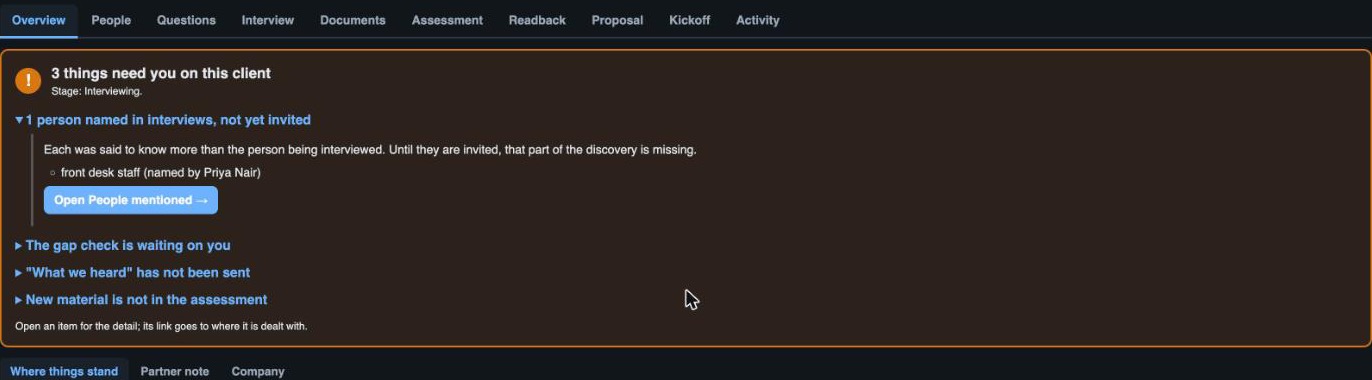
- What needs you. One overview across every client, written fresh when something changes: the most important thing today, then each client's list.
- A summary on every tab. Each tab opens with a card: green when it is current, amber when something has overtaken it or is missing, with what it was built from.
- Alerts with the action attached. People named and not invited, a gap check waiting, a proposal with no fee, an interview not written up: each opens to its detail and a button that takes you there.
- Whose turn it is. Every client shows its next step and whether it is waiting on you or on them, and for how long.
- A report. Open discoveries, interviews held, opportunities found, savings identified, proposals out and signed, and what it all cost.
- Limits and alerts on spend. A cap on interview time for each person, and an alert when a client passes the voice minutes or AI spend you set.
- Roles, audit and deletion. Admin, editor and read-only roles, access limited client by client, passkeys and two-step sign-in, an audit trail, and deletion of a client's material on request.
Why DiscoverPro
One product for the whole path, not four tools stitched together.
Each step has its own software today. None of it carries a deal from the first email to the signed project.
| What firms use today | What it does | Where it stops |
|---|---|---|
| Outreach and AI sales-rep tools | Find contacts, research, send sequences | At the first meeting. Many send without a person reading the message. |
| AI interview platforms | Run interviews at scale for research teams | At a research report. No sizing in dollars, no proposal. Usually priced by quote. |
| Proposal and Statement of Work writers | Draft a proposal from notes you paste in | They start after discovery, and are only as good as the notes. |
| Slides, documents and e-signature | Decks, agreements, signing | Built by hand each time, in three more tools. |
- End to end. First contact through signed proposal and kickoff, with the research and the client's own words carried all the way.
- Built for firms selling a project. It ends in a scoped, priced proposal, not a research report.
- Sized in dollars. Every problem is costed from the client's own figures, then the work is priced and papered.
- A person approves everything. AI prepares. Your people decide what a prospect or a client sees.
- Published pricing. Outreach and Discover in every plan, with the prices on this page.
What it saves
About 470 hours a month back to your team.
A discovery done by hand takes a small firm about a week and a half of someone's time, and every company you write to takes half an hour of research. At 6 discoveries and 300 companies a month, DiscoverPro gives back about 470 hours, worth about $71,000 at $150 an hour. That is nearly three people's working month.
Researching a company, finding the right contact and writing a specific first note takes about 35 minutes by hand. Reviewing what DiscoverPro prepared takes about 5. That is 30 minutes, or $75, on every company.
No questions to prepare, and no interviews to run or write up. That is about 15 hours, or $2,300, on every discovery.
Scheduling, sizing, the decks, the proposal and the Statement of Work arrive as drafts to check. That is about 39 hours, or $5,800, on every discovery.
Against $1,299 a month for the Practice plan, which covers this volume.
See the hours, line by line
| Work on one discovery | By hand | With DiscoverPro |
|---|---|---|
| Preparing the questions | 3 h | 0.5 h |
| Scheduling and chasing interviews | 4 h | 0.5 h |
| Running the interviews | 8 h | 0 h |
| Writing up notes | 6 h | 1 h |
| Finding the problems, sizing them, researching tools | 12 h | 2 h |
| Summary for the client to confirm | 2 h | 0.25 h |
| Readback deck | 7 h | 0.75 h |
| Proposal and Statement of Work | 8 h | 1.25 h |
| Proposal and kickoff decks | 5 h | 0.5 h |
| A senior review of everything before it goes out | 6 h | in the lines above |
| Total | about 61 h | about 7 h |
| At $150 an hour | $9,150 | $1,050 |
Work it out for your firm
The assumptions behind these numbers
- A discovery means four people interviewed for about an hour each, one readback and one proposal with a Statement of Work.
- By hand, two of your people sit in each interview, notes take an hour and a half per interview, and a senior person reviews everything before it goes to the client.
- With DiscoverPro, the time left is reading, correcting and approving what it prepared. Calls with the client (the readback, the proposal, the kickoff) are not counted on either side, because you hold them either way.
- Researching a company and writing a specific first note takes about 35 minutes by hand and about 5 to review.
- An hour of your team's time is valued at $150 unless you enter your own. In salary mode, an hour costs the salary plus 30% for overheads, over 2,080 hours a year.
- The monthly figures assume 6 discoveries and 300 companies researched. "Weeks to reach a proposal" and "about sixty hours" describe a small consultancy working by hand, on these same assumptions.
- These are our estimates, not measurements from customers. Use the calculator with your own numbers.
Estimates for a typical discovery: four people interviewed, one readback, one proposal, compared with how a small consultancy usually does the same work by hand. With DiscoverPro the time left is the review itself: reading, correcting and approving. Dollar figures use $150 for an hour of your team's time. Your own figures will differ.
Make it yours
Describe your firm once. Everything it writes follows from that.
DiscoverPro does not sound like a generic tool because it starts from who you are: who you sell to, what you build, how you write, your paperwork and your prices.
- Your ideal customer. The size of company you work with, the countries you serve and the kinds of business you do not want. Outreach checks every company against it and scores the ones that fit.
- What you sell. Your offer, in your words. Research looks for the problems you solve, and every draft is written from it.
- What you build, and what you will not take on. Your list of services. The assessment recommends from it and says plainly when something is outside it.
- Your NDA. Your mutual non-disclosure agreement, signed online by the client before the first question.
- Your Master Services Agreement. Your template, attached to every proposal with the client's name filled in.
- Statements of Work written for each project. You give one example. AI writes a new one for every engagement from the approved scope, with an acceptance test for each deliverable, and never writes a price.
- Your price list. A fee for small, medium and large work, and your managed service as a share of it. Proposals are priced from it automatically.
- Your outreach writing style and tone. Voice notes for each person who sends, a template for each kind of message, and a list of phrases you never want used. Every draft is written to them, and one that breaks your rules is held back.
- Your brand. Your firm's name, logo and footer on every deck and document, and your people's names on every email.
- Your interviewer. The name it gives, the voice it speaks in, the questions it must always ask, and a playbook of how your firm likes an interview run.
- Your wording. Every email a client receives, from the invitation to the reminder, in your words, in English and Spanish.
And you stay in control.
A person signs off
Questions, emails, assessments, readbacks and proposals all wait for approval. You can edit every one before it goes.
Evidence, not impressions
Findings come from what the client said and showed. The system is told never to fill a gap with a guess, and every claim links to its source.
Numbers you can check
Dollar figures are calculated from the client's inputs. Prices come from your price list. Neither is written by AI.
Private from the start
An NDA comes before the first question. What a client shares is never used to train AI models, and you can delete a client's material on request.
Security · How AI is used · Can AI run a discovery interview? · Privacy · Data processing
Pricing
Simple pricing. Outreach and Discover in every plan.
Pick a plan by how many discoveries you run and how many companies you research in a month. There is nothing to add on.
Founding customers
20% off your first month.
For the first five firms. In return we ask for a 30-minute feedback call and your permission to publish a short case study with your results. Any plan; cancel any time.
Solo
For a consultant working alone
$499 a month
- 2 discoveries a month
- 150 companies researched a month
- 1 user
Practice
For a small firm
$1,299 a month
- 6 discoveries a month
- 500 companies researched a month
- 5 users
Firm
For a larger practice
$2,999 a month
- 20 discoveries a month
- 1,500 companies researched a month
- Unlimited users
Enterprise
For several teams or high volume
Custom
- More than 20 discoveries a month
- Company research at your volume
- Several practices or teams
- Security review and a data processing agreement
- Onboarding for your people
- Annual invoicing
- In every plan. AI interviews by voice or keyboard, assessments, readbacks, proposals, agreements, online signing, all three decks, and every part of Outreach.
- When you go over. $250 for each extra discovery and $0.75 for each extra company researched. Nothing stops mid-month.
- Voice, fair use. Each discovery includes 300 minutes of spoken interview, enough for ten people at half an hour each. Beyond that it is $0.25 a minute. Typed interviews are not counted.
- Your own data providers. If you search Apollo, Hunter or A-Leads from Outreach, you connect your own account with them. Their fees are theirs and are not part of a plan.
Prices in US dollars, billed monthly. Secure card checkout through Stripe is coming soon; until then, Subscribe takes your details and we set your plan up with you.
Questions
What firms ask first.
Is an AI interviewer good enough for a real discovery?
It is built for it, and it does not work alone. It does not read from a fixed script: it covers the ground for each person's role, follows up on what they say, and keeps track of what is covered and what is still missing. It starts by saying it is an AI and that the conversation is recorded, plays back what it heard, and stops at a time limit. People can share a document or record their screen when showing is easier than telling. Then your consultants take over: a gap check shows what is thin, you send follow-up questions or pick up the phone, and the client confirms the summary before anything is built on it. How it does each thing a discovery interview demands.
Does the AI pretend to be a person?
No. The interviewer says it is an AI at the start of every conversation, tells the person the conversation is recorded, and they can ask for a person at any time.
Can I change what it writes?
Yes. Questions, the assessment and its figures, "what we heard", the readback, the proposal and the Statement of Work are all drafts until you approve them, and each can be edited.
Where do the numbers come from?
From the client. How often something happens, how long it takes and what a mistake costs are taken from their answers and files, shown with the arithmetic, and can be corrected by you. Where the client gave no figure, it says so rather than estimating.
Which AI does it use?
Anthropic's Claude does the reading and writing, and ElevenLabs provides the interviewer's voice and speech recognition. Neither is allowed to train on what is sent. You choose which model does which job. More on how AI is used.
What languages does it work in?
English and Spanish, for interviews and the pages your clients use.
Do I have to use both Outreach and Discover?
No. Both come with every plan, and each works without the other. If you already have clients to run discoveries with, start with Discover.
What does it cost?
From $499 a month, with Outreach and Discover both included. See the plans.
Book a demo
See it run on a client like yours.
Thirty minutes, on a call. We run a short interview, show the assessment it produces, and walk through the readback and the proposal. Bring a real client situation if you like.
We use what you send only to reply to you. Privacy
Sign in